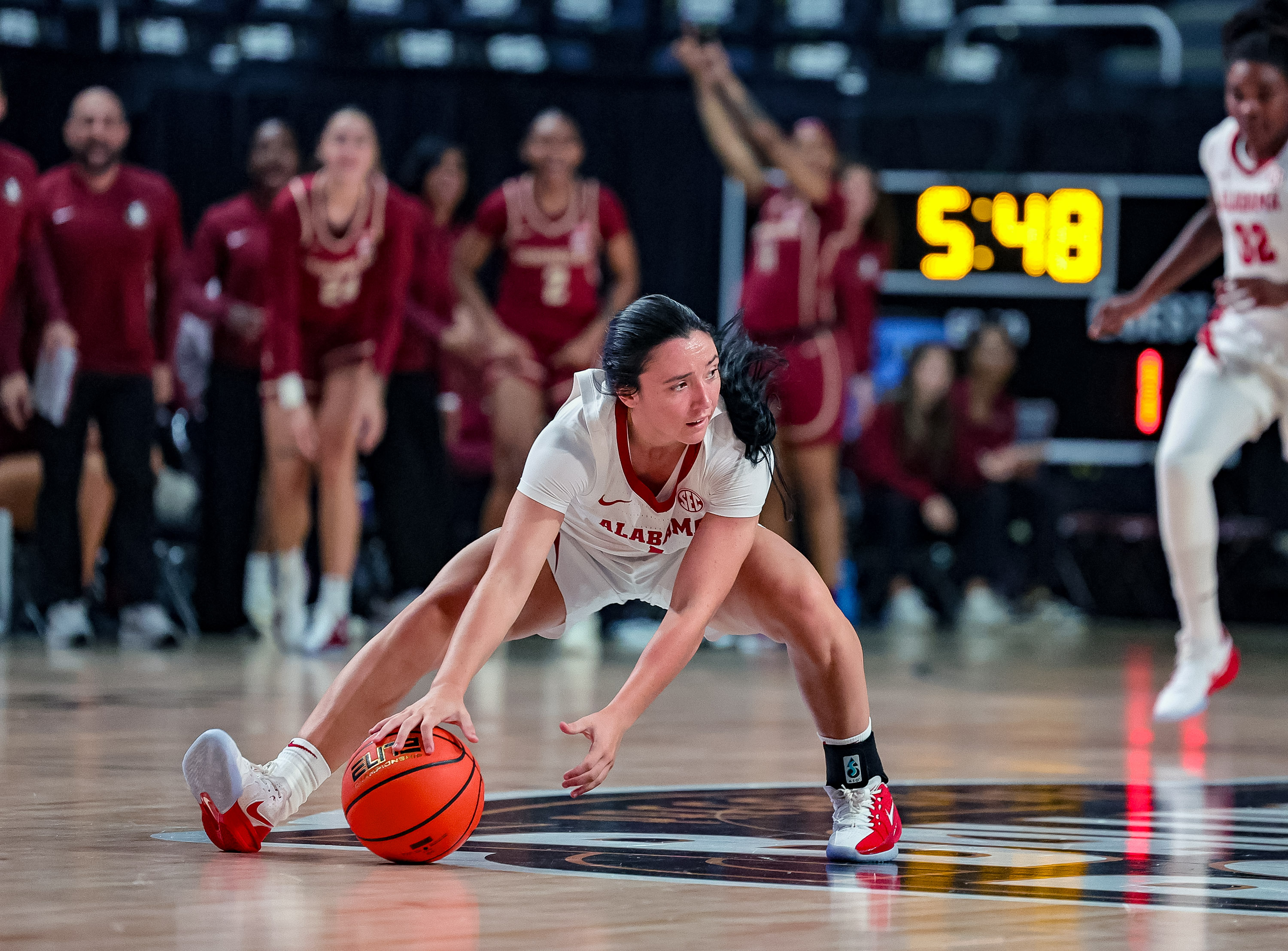
By Chase Brumfield
A new era of Alabama women’s basketball is underway.
After finishing the 2025-26 season with a 24-11 record and reaching the second round of the NCAA Tournament, the Crimson Tide enters the 2026-27 season with a new head coach, a revamped roster and a new identity to establish.
Alabama’s season ended with a heartbreaking 69-68 loss to Louisville in the NCAA Tournament. Karly Weathers’ three-pointer with four seconds remaining nearly sent the Crimson Tide to its first Sweet 16 appearance since 1998, but Louisville held on to advance. Freshman guard Ace Austin led Alabama with 17 points in the loss, including five three-pointers.
The offseason brought significant change.
Kristy Curry departed Alabama for South Florida, and athletic director Greg Byrne turned to Pauline Love to lead the program into its next chapter. Love was introduced as Alabama’s 10th head coach on April 1 and returned to Tuscaloosa after spending the 2025-26 season as associate head coach at Oklahoma.
We are thrilled to welcome Pauline back to Tuscaloosa. Throughout this process, we spoke with several people, and she quickly rose to the top of that list. Pauline’s vision for this program and preparation to lead Alabama women’s basketball is incredibly impressive, and we look forward to seeing the Tide continue to rise under her leadership.
Love brings extensive SEC experience and a strong recruiting background to Alabama. Before her season at Oklahoma, she spent the 2024-25 season at Alabama as an assistant coach and recruiting coordinator. She previously spent seven seasons at Arkansas, where she served as an assistant coach and recruiting coordinator, after beginning her coaching career at Southern Mississippi and McNeese State.
Her most recent season at Oklahoma provided another opportunity to work within a successful SEC program. The Sooners finished 26-8, reached the Sweet 16 and averaged 85.9 points per game, which ranked among the top five nationally. Love also helped with the development of first-team All-SEC and All-America honoree Reagan Beers and national freshman of the year Aaliyah Chavez.
Now, Love has the opportunity to build her own program in Tuscaloosa.
I’m incredibly honored to lead the Alabama women’s basketball program. This is a place with a championship standard, and we’re going to build a team that reflects that every day through toughness, togetherness and trust. I’m excited to get to work with our players, connect with this community and build something special in Tuscaloosa. I want to thank Greg Byrne, President Mohler and the Board of Trustees for this opportunity
A New-Look Alabama Roster:
The biggest storyline entering the season may be how quickly Alabama can turn a dramatically different roster into a cohesive team.
The Crimson Tide returns only four players from last season: Ace Austin, Leah Brooks, Tianna Chambers and Naomi Jones. Alabama added nine newcomers through the transfer portal, including Amirah Anderson, Paris Bradley, Rickell Brown, Brooke Coffey, Mykelle Richards, Aaliyah Roberson, Caitlin Staley, Kylie Torrence and Alayna West.
That amount of roster turnover creates both opportunity and uncertainty.
There is an opportunity for players who were previously in supporting roles to take on larger responsibilities, while the newcomers have the chance to establish themselves within Love’s system. At the same time, Alabama will have to develop chemistry quickly, particularly with SEC play beginning on Dec. 31.
One player who could have an important role in that transition is Austin.
As a freshman last season, Austin showed flashes of what she could become. Her performance against Louisville was perhaps the clearest example. She scored 17 points and knocked down five three-pointers against the Cardinals, demonstrating the shooting ability that could become an important part of Alabama’s offense.
Love has already challenged Austin to take on more responsibility.
We put a lot of pressure on her during the summer only because we feel like this can be her team. She is from the state, she loves the state just as anybody. We put a lot of pressure on her to take over the team and take a little ownership. It was rough on her in the beginning just because she is trying to adjust to everybody because everyone is so new. With her, I only have four returners so nine new players. We put a lot of pressure on her, she has been great. She has handled it well.
For Austin, the challenge will be more than simply increasing her scoring production. She will have to become one of the players Alabama can rely on to handle the basketball, create opportunities for teammates and provide stability when games become tight.
That development could be especially important considering the amount of new talent around her.
Finding Production in the Frontcourt:
While the backcourt will receive plenty of attention, Alabama also has several new options in the frontcourt.
Jones returns as one of the Tide’s most experienced interior players, while the addition of 6-foot-4 forwards Staley and Roberson gives Love additional size. Richards and Torrence also provide more frontcourt options.
That size could become particularly important against SEC opponents.
Last season, Alabama averaged 36.5 rebounds per game and held a 1.5-rebound margin over its opponents. The Tide also averaged 4.6 blocks per game.
Maintaining that level of interior production will be important as Alabama faces a conference filled with talented frontcourts.
The challenge will be determining which players become Alabama’s primary rebounders, interior scorers and defensive anchors.
Staley is an intriguing addition in that regard. At 6-foot-4, she gives Love another option around the basket and could benefit from a system designed around utilizing the team’s size and versatility.
But the key may not be finding one dominant post player.
Instead, Alabama could need several players to consistently contribute on the glass, defend without fouling and finish around the basket.
Can the Guards Create Consistency?
The other major question surrounds Alabama’s guard play.
Last season, the Crimson Tide averaged 70.0 points per game while shooting 36.4 percent from three-point range. Alabama also averaged 13.7 assists and 14.9 turnovers per game.
Those numbers illustrate an important area for improvement: Alabama must find ways to create offense consistently while limiting empty possessions.
Austin will be part of that equation, but she will not have to carry the entire responsibility.
Love’s roster includes several guards with different skill sets, including Anderson, Coffey, Brown, Bradley, and West. The competition for minutes could ultimately help Alabama establish more depth in the backcourt.
The question is which combination of guards will give Love the best balance of scoring, ball security, playmaking and perimeter defense.
That answer may change throughout the season.
The Importance of Chemistry:
Perhaps the biggest challenge facing Alabama is one that cannot be measured through a box score.
Chemistry.
Nine newcomers means Love and her staff have to establish a system while also building relationships and defining roles. Alabama’s first official practice on Sept. 21 marked the beginning of that process.
For a team with this much turnover, the early portion of the schedule could be particularly valuable.
Alabama has 16 non-conference games before beginning SEC play, giving the Tide significant time to determine its rotation and establish its identity.
The goal will not simply be winning games during that stretch.
It will be figuring out what Alabama does well.
Does the team want to push the tempo? Can it consistently defend at a high level? Which players can create their own shots? How does Love want to utilize her size? Who becomes the team’s primary facilitator?
Those questions will begin to receive answers during the non-conference portion of the schedule.
A Non-Conference Schedule With Opportunities:
Alabama’s schedule provides several opportunities to test itself before SEC play begins.
The Crimson Tide opens the regular season Nov. 2 against Queens before facing New Orleans and Alabama A&M. Alabama will then travel to Tulane on Nov. 8 and Memphis on Nov. 12.
The biggest early test comes at the WBCA Showcase in Orlando.
Alabama will face Florida A&M on Nov. 19 before meeting North Carolina on Nov. 21. The showcase features eight teams, including Alabama, North Carolina, Florida State, Purdue, Texas Tech, UCF, USF and Florida A&M.
The matchup with North Carolina should provide an early measuring stick for Love’s team. The Tar Heels and Crimson Tide last met in the NCAA Tournament in 2021, when Alabama defeated North Carolina 80-71.
Alabama will also host Georgia Tech on Dec. 3 as part of the ACC/SEC Challenge.
These games should give Love opportunities to see how her team responds to different styles of play before the conference schedule arrives.
The SEC Test:
Then comes the biggest challenge.
Alabama opens SEC play on Dec. 31 at South Carolina before returning home to face Georgia on Jan. 3. The Tide will also host Florida, LSU, Missouri, Auburn, Vanderbilt, Ole Miss and Texas A&M during conference play.
On the road, Alabama will face South Carolina, Ole Miss, Texas, Tennessee, Kentucky, Oklahoma, Arkansas and Mississippi State.
The conference schedule offers little room for Alabama to ease into SEC competition.
The Tide’s first conference game comes against South Carolina, followed by a home matchup with Georgia just three days later. From there, Alabama will face a variety of teams with different styles and levels of experience.
The Iron Bowl will also return to Coleman Coliseum on Feb. 7 when Auburn comes to Tuscaloosa.
For Love, these games will provide the clearest indication of how quickly Alabama’s new roster has developed.
The Biggest Questions:
With a new head coach, nine newcomers and only four returning players, there are several questions surrounding Alabama entering the 2026-27 season.
Who becomes Alabama’s primary scorer?
Last season, Alabama had multiple players capable of providing offensive production. With much of that production now gone, the Tide will have to identify where its scoring comes from.
Austin appears to be one candidate after showing flashes as a freshman, but Alabama’s collection of newcomers also gives Love several options. Finding a consistent scoring threat will be one of the most important pieces of establishing the team’s offensive identity.
Can Austin make the jump from promising freshman to team leader?
Austin’s development may be one of the biggest storylines of the season.
She enters her sophomore season after scoring 17 points and making five three-pointers against Louisville in Alabama’s NCAA Tournament loss. Love has already challenged Austin to take more ownership of the team, meaning her role could extend well beyond simply putting points on the scoreboard.
The question will be whether Austin can turn those flashes into consistent production while becoming one of the voices Alabama relies on throughout the season.
Which newcomer earns a major role?
Nine transfers give Love a deep pool of new talent to work with, but not everyone can have the same role.
The preseason will be important for determining which newcomers separate themselves from the rest of the roster. Whether it is a guard providing scoring and ball-handling, a wing bringing defensive versatility or a post player providing rebounding and interior scoring, Alabama will need several newcomers to make an immediate impact.
How quickly can nine transfers develop chemistry?
This may be the most important question of them all.
Alabama has just four returning players, meaning Love is essentially building a new team around a small group of players who already understand the program.
Chemistry cannot be measured through a statistic. It develops through practices, games, communication and experience playing alongside one another.
The good news for Alabama is that the team has 16 non-conference games before SEC play begins. That gives Love and her staff valuable time to determine rotations, establish roles and figure out which combinations work best together.
What will Love’s offensive identity look like?
Love’s arrival also brings an opportunity to establish a new offensive identity.
During her time at Oklahoma, Love was part of a team that averaged 85.9 points per game and reached the Sweet 16. Alabama averaged 70.0 points per game last season.
That does not necessarily mean Alabama will immediately become a high-scoring team, but it does provide an interesting point of comparison.
Will Love push the pace? Will she emphasize three-point shooting and guard play? Will Alabama use its size more heavily in the frontcourt?
Those answers should become clearer as the season progresses.
Can Alabama maintain its rebounding and defensive production?
Offense will receive much of the attention, but Alabama’s ability to defend and rebound could be equally important.
The Crimson Tide averaged 36.5 rebounds and 7.7 steals per game last season while also recording 4.6 blocks per game.
With several new players entering the rotation, maintaining that level of defensive intensity and rebounding will require everyone to understand their responsibilities.
The frontcourt will be particularly important when Alabama faces some of the SEC’s bigger lineups.
How will the Tide handle the opening stretch of SEC play?
Finally, Alabama will have to adjust quickly once conference play begins.
Opening SEC play at South Carolina on Dec. 31 before hosting Georgia on Jan. 3 gives Love’s team an immediate test.
By that point, the Tide should have a much clearer identity than it does in September. But the SEC will provide a different level of competition and pressure than the non-conference schedule.
How Alabama responds to that transition could tell us a lot about the team’s development.
What Will Define the 2026-27 Season?
For Alabama, this season may ultimately come down to three things: chemistry, consistency and identity.
The roster has talent and size. Love has SEC experience and a strong recruiting background. But putting those pieces together is the challenge.
Alabama enters the season coming off five consecutive 20-win seasons and its fifth NCAA Tournament appearance in the last six years. The standard established by the previous era remains high, but the program is now entering a new chapter.
Love’s first season will provide the first glimpse of what that chapter looks like.
Austin’s development will be worth watching. The competition for backcourt minutes could shape the team’s identity. The production of Jones and Alabama’s newcomers in the frontcourt could determine how the Tide handles bigger SEC opponents.
And perhaps most importantly, the team’s ability to build chemistry could determine how quickly Love’s vision translates from practice to the court.
The 2026-27 season is not simply about replacing what Alabama lost.
It is about discovering what Alabama can become under Love.